
Optimizing IT Staffing: Security Analyst (SIEM / CISSP) Playbook for Leaders
Learn how to effectively staff Security Analyst roles with SIEM/CISSP credentials using APO strategies for enhanced efficiency and compliance.
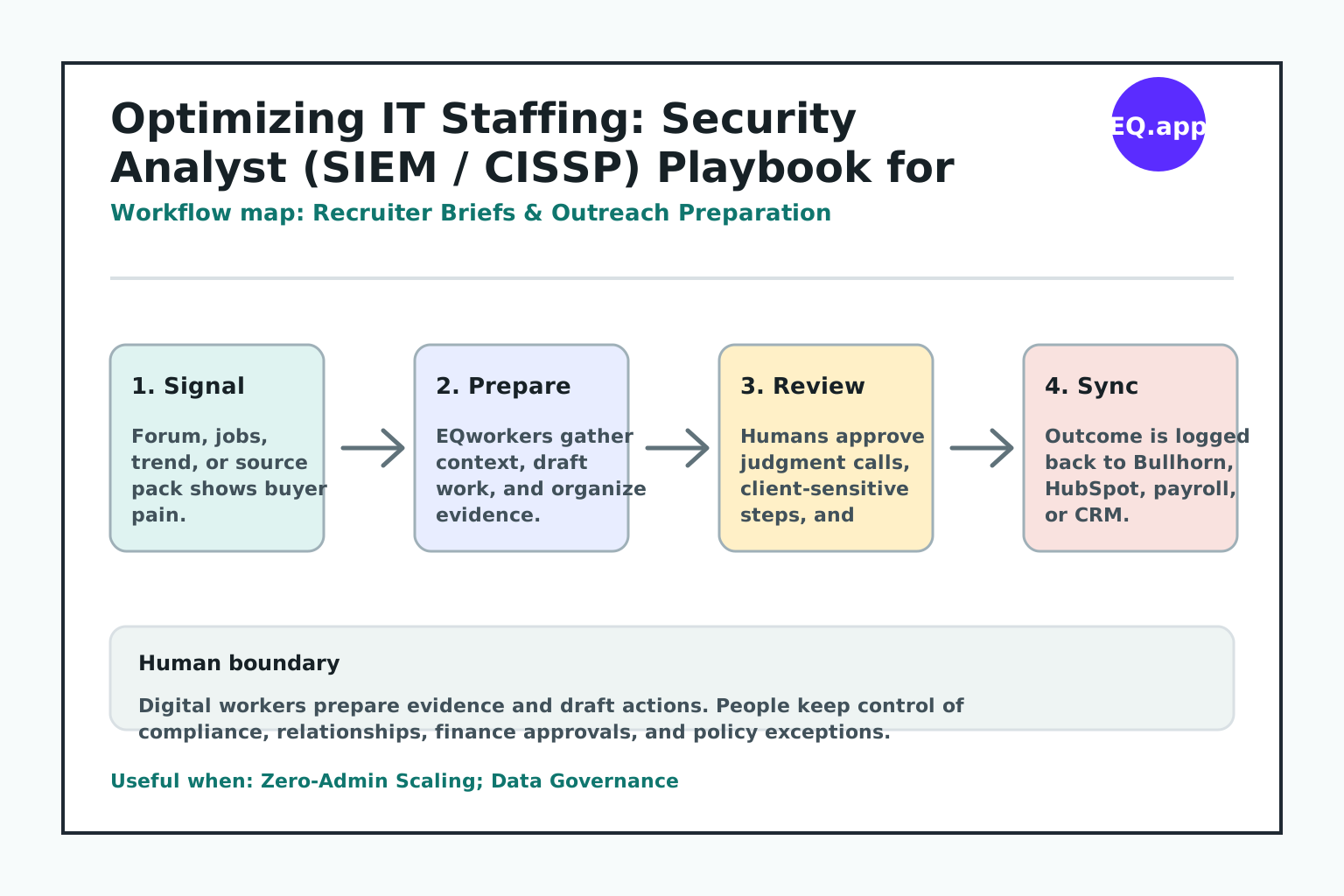
Direct answer: This APO blueprint explains how staffing leaders can evaluate repeatable staffing operations work that can be prepared, routed, monitored, and logged by governed digital workers as an Agentic Process Outsourcing workflow. The operating model moves repeatable preparation, routing, monitoring, and evidence collection into governed EQworkers while humans retain control of judgment, exceptions, client-sensitive communication, and approvals.
Publisher context: APO Registry by EQ.app maps Agentic Process Outsourcing for staffing leaders and connects this article to the APO Reference Hub.
Staffing leaders should integrate Agentic Process Outsourcing (APO) to streamline hiring for Security Analysts with SIEM/CISSP credentials, reducing administrative overhead and ensuring compliance. This approach leverages digital workflows to optimize recruitment and onboarding, allowing human resources to focus on strategic tasks.
Why does this matter for staffing leaders?
Efficient recruitment of Security Analysts is crucial due to high demand and the complexity of managing credentials like SIEM and CISSP. Traditional methods are resource-intensive and slow, affecting operational efficiency and competitive positioning. Adopting APO reduces the need for additional administrative hires, improving margins and enabling zero-admin scaling.
How does APO integration transform the hiring process?
APO automates repetitive tasks and ensures workflows are executed within a governed digital environment. This includes automating candidate screening, credential verification, and compliance checks, traditionally manual and time-consuming tasks. Digital workers handle these tasks, escalating exceptions to human recruiters only when necessary.
How does this workflow connect to Bullhorn and HubSpot?
| Input | EQworker Action | Human Review | System Sync |
|---|---|---|---|
| Candidate Application | Automated Screening | Review Exceptions | Update Bullhorn |
| Credential Verification | Check SIEM/CISSP | Approve Verified | Sync with HubSpot |
| Compliance Check | Automate Checks | Handle Exceptions | Log Compliance |
What are the benefits of using APO for Security Analyst roles?
APO reduces administrative costs, accelerates recruitment cycles, and enhances compliance management. By automating routine tasks, staffing firms can allocate human resources to strategic activities like relationship building and candidate engagement, enhancing competitive edge.
What are the risks and limitations of current staffing methods?
Current methods involve high administrative overhead and are prone to human error, especially in credential verification and compliance management. These inefficiencies lead to delays, increased costs, and compliance risks. Without APO, firms struggle to scale operations efficiently, impacting their ability to meet client demands.
What is a concrete example of APO in action?
A staffing firm traditionally required multiple administrative staff to handle applications for Security Analyst positions. Implementing APO automated initial screening and credential verification, reducing manual intervention. This led to a 30% reduction in time-to-hire and decreased administrative costs.
How should staffing leaders evaluate APO integration?
- Assess current administrative workflows to identify repetitive tasks suitable for automation.
- Evaluate potential integration of APO with existing systems like Bullhorn and HubSpot.
- Consider compliance and security implications of digital worker deployment.
- Plan for human oversight in areas requiring judgment and client interaction.
Frequently Asked Questions
- How does APO handle sensitive candidate data? APO operates within a secure, governed environment, ensuring data privacy and compliance with regulations.
- Can APO completely replace human recruiters? No, APO handles non-human tasks, allowing recruiters to focus on strategic activities and relationship management.
- What is the cost comparison between APO and traditional staffing methods? APO significantly reduces costs by automating repetitive tasks, with digital workers operating at a fraction of the cost of human staff.
What leaders should do this week
- Schedule a Zero-Admin Operations Assessment with EQ.app to evaluate APO integration potential.
- Review current staffing workflows to identify areas for automation.
- Engage with IT and compliance teams to ensure secure integration of digital workers.
- Communicate the benefits of APO to stakeholders to gain buy-in for implementation.
What this means for the CEO/CFO/operator
Integrating APO into staffing operations can significantly expand margins by reducing administrative drag and improving operational efficiency. This positions the firm for zero-admin scaling, allowing growth without proportional increases in administrative headcount. Firms leveraging APO can tell stronger valuation stories, appealing to investors and stakeholders by showcasing higher-margin operations and robust data governance.
Ready to optimize your IT staffing operations? Schedule a Zero-Admin Operations Assessment with EQ.app today.
The best operators are not asking whether AI will affect staffing. They are asking which back-office workflows should no longer be done manually.
Agentic Process Outsourcing (APO) works best when leaders identify one repeatable workflow, define the Human review, and deploy governed EQworkers to prepare, route, monitor, and log the digital work. The goal is not to remove human judgment; it is to move non-producing administrative drag out of the role so staffing teams can focus on trust, relationships, and exceptions.
The Human review should be explicit: client-sensitive messages, compliance exceptions, finance escalations, candidate relationship decisions, and policy overrides stay with accountable human owners. EQworkers prepare the evidence, draft the action, route the exception, and log the outcome inside governed systems.
Ready to apply this workflow?
Staffing firms create operating leverage by finding repeatable back-office work that can be prepared, routed, monitored, and logged by governed EQworkers while humans keep control of judgment, relationships, and exceptions.
Use the APO Reference Hub, APO vs BPO Cost Matrix, and APO Cost Calculator to evaluate where this workflow fits.
Ready to benchmark your firm's administrative efficiency? Book a Zero-Admin Operations Assessment with the EQ Team to identify the first workflow that should move into an APO operating model.
Ready to apply this workflow?
Staffing firms create operating leverage by finding repeatable back-office work that can be prepared, routed, monitored, and logged by governed EQworkers while humans keep control of judgment, relationships, and exceptions.
Use the APO Reference Hub, APO vs BPO Cost Matrix, and APO Cost Calculator to evaluate where this workflow fits.
Ready to benchmark your firm's administrative efficiency? Book a Zero-Admin Operations Assessment with the EQ Team to identify the first workflow that should move into an APO operating model.
Ready to apply this workflow?
Staffing firms create operating leverage by finding repeatable back-office work that can be prepared, routed, monitored, and logged by governed EQworkers while humans keep control of judgment, relationships, and exceptions.
Use the APO Reference Hub, APO vs BPO Cost Matrix, and APO Cost Calculator to evaluate where this workflow fits.
Ready to benchmark your firm's administrative efficiency? Book a Zero-Admin Operations Assessment with the EQ Team to identify the first workflow that should move into an APO operating model.
Ready to apply this workflow?
Staffing firms create operating leverage by finding repeatable back-office work that can be prepared, routed, monitored, and logged by governed EQworkers while humans keep control of judgment, relationships, and exceptions.
Use the APO Reference Hub, APO vs BPO Cost Matrix, and APO Cost Calculator to evaluate where this workflow fits.
Ready to benchmark your firm's administrative efficiency? Book a Zero-Admin Operations Assessment with the EQ Team to identify the first workflow that should move into an APO operating model.
Benchmark this workflow with EQ.app
Staffing firms create operating leverage by finding repeatable back-office work that can be prepared, routed, monitored, and logged by governed EQworkers while humans keep control of judgment, relationships, and exceptions.
Use the APO Reference Hub, APO vs BPO Cost Matrix, and APO Cost Calculator to evaluate where this workflow fits.
Ready to benchmark your firm's administrative efficiency? Book a Zero-Admin Operations Assessment with the EQ Team to identify the first workflow that should move into an APO operating model.
Ask AI about this article
Open a separate AI tool with a prefilled question about EQ.app, APO, and this article.
Comments ()